Supply and Demand Zone Trading: The Complete Step-by-Step Strategy Guide
Learn exactly how to trade a supply and demand zone from start to finish. This practical guide covers everything from zone identification to trade management with real examples.
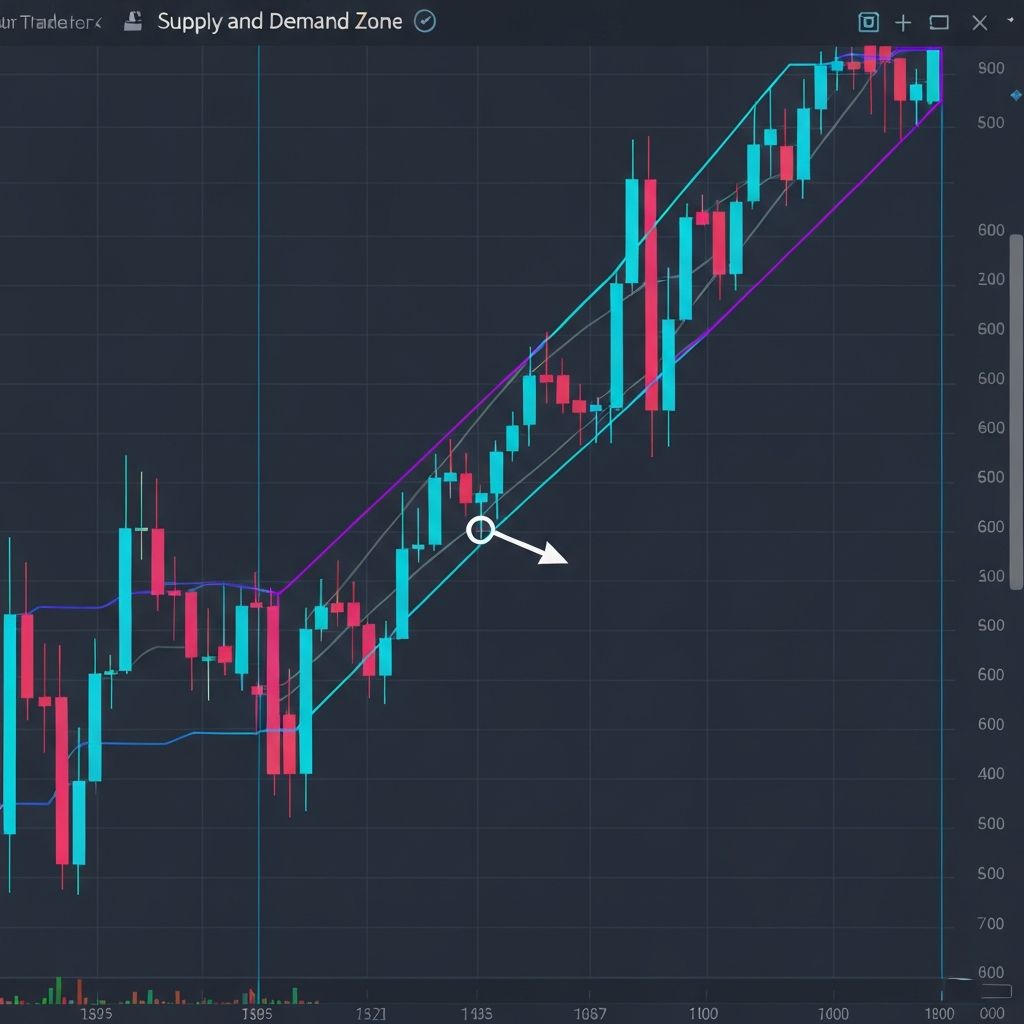
Trading a supply and demand zone successfully requires more than just knowing how to draw rectangles on a chart. It requires a complete system that covers zone selection, entry timing, risk management, and trade execution. This guide provides that complete system.
Whether you are new to supply and demand zone trading or looking to refine your existing approach, this step-by-step strategy guide will give you actionable rules you can apply immediately. Every concept is explained with practical examples so you can start trading with confidence.
What You Will Learn
- How to identify a high-probability supply and demand zone
- Exact entry rules for both aggressive and conservative traders
- Where to place your stop loss for optimal protection
- How to set profit targets using zone-to-zone analysis
- Trade management techniques to maximize profits
Understanding What Makes a Supply and Demand Zone Work
A supply and demand zone represents an area of unfilled orders from institutional traders. When banks and hedge funds need to buy or sell large positions, they cannot do it all at once without moving the market against themselves. Instead, they place orders gradually, and when price moves away before all orders are filled, those remaining orders create the zone.
Demand Zone Mechanics
When institutional buyers cannot fill all their buy orders at a certain price, those unfilled orders remain. When price returns to this level, the remaining buy orders get triggered, pushing price back up.
- Forms at price lows
- Indicates buying interest
- Look for long entries here
Supply Zone Mechanics
When institutional sellers cannot fill all their sell orders at a certain price, those unfilled orders remain. When price returns to this level, the remaining sell orders get triggered, pushing price back down.
- Forms at price highs
- Indicates selling interest
- Look for short entries here
Step 1: Finding a Tradeable Supply and Demand Zone
The first step in trading any supply and demand zone is finding one worth trading. Not every zone on the chart deserves your attention. Here is the systematic process for finding high-quality zones:
Zone Discovery Process
1. Start with the Higher Timeframe
Begin on the daily or weekly chart to understand the overall market structure. Identify the prevailing trend and major swing points. This gives context for all lower timeframe analysis.
2. Look for Explosive Moves
Scan the chart for strong, impulsive price movements. These are characterized by large candles moving in one direction with minimal retracement. The origin of these moves is where zones form.
3. Identify the Base Formation
At the origin of the explosive move, look for 1-3 candles that formed the base. These candles should be relatively small compared to the departure candle. This consolidation is your zone.
4. Draw the Zone Boundaries
Mark the zone from the lowest point (including wicks) to the highest body of the base candles. For supply zones, focus on the upper portion. For demand zones, focus on the lower portion.
Pro Tip: Zone Refinement
Once you identify a zone on a higher timeframe, drop down to a lower timeframe to refine the boundaries. A zone drawn on the 4-hour chart can be made more precise by examining the 1-hour or even 15-minute chart at that same price area.
Step 2: Validating Zone Quality
After identifying a potential zone, you need to validate its quality before considering a trade. Use this scoring system to evaluate each zone:
Departure Strength
Max 3 points- 3 points: Explosive move with large candles, breaks structure
- 2 points: Strong move but does not break major structure
- 1 point: Moderate move, average-sized candles
- 0 points: Weak move, should not trade this zone
Time at Level
Max 2 points- 2 points: 1-2 base candles before departure
- 1 point: 3-4 base candles before departure
- 0 points: 5+ base candles (too much time, orders likely filled)
Freshness
Max 3 points- 3 points: Never been tested (fresh zone)
- 2 points: Tested once with strong reaction
- 1 point: Tested twice
- 0 points: Tested more than twice (zone is exhausted)
Trend Alignment
Max 2 points- 2 points: Zone aligns with higher timeframe trend
- 1 point: Zone in ranging market
- 0 points: Zone against the trend (counter-trend)
Zone Quality Score Guide
8-10
High Quality - Trade with full size
5-7
Medium Quality - Trade with reduced size
0-4
Low Quality - Skip this zone
Step 3: Entry Strategies for Supply and Demand Zone Trading
There are two main approaches to entering trades at a supply and demand zone. Choose based on your risk tolerance and trading style:
Aggressive Entry
Place a limit order at the edge of the zone and wait for price to reach it. No confirmation required.
For Demand Zones:
Limit buy at the top edge of the zone
For Supply Zones:
Limit sell at the bottom edge of the zone
Pros: Better entry price, simple execution
Cons: More false signals, price may not reach zone
Conservative Entry
Wait for price to enter the zone AND show a confirmation pattern before entering.
Confirmation Patterns:
- - Engulfing candle in zone direction
- - Pin bar / hammer at zone edge
- - Break of micro structure
Pros: Higher win rate, fewer false signals
Cons: Worse entry price, may miss fast moves
Important Entry Rule
Never enter a trade before price reaches your zone. Anticipating that price will get to your zone and entering early is a common mistake that destroys trading accounts. Wait for price to actually enter the zone before taking any action.
Step 4: Stop Loss Placement
Proper stop loss placement is critical for supply and demand zone trading. Your stop needs to be far enough to avoid getting hit by normal volatility, but tight enough to maintain a good risk-reward ratio.
Stop Loss Rules
Demand Zone (Long Trades)
Place stop loss below the demand zone
- - Standard: 5-10 pips below zone low
- - Aggressive: Just below zone low
- - Conservative: Below the swing low that formed the zone
Supply Zone (Short Trades)
Place stop loss above the supply zone
- - Standard: 5-10 pips above zone high
- - Aggressive: Just above zone high
- - Conservative: Above the swing high that formed the zone
Stop Loss Calculation Example
Scenario: Trading EUR/USD with a demand zone between 1.0850 and 1.0870
Entry: Limit buy at 1.0865 (middle of zone)
Stop Loss: 1.0840 (10 pips below zone)
Risk: 25 pips (1.0865 - 1.0840)
With a $10,000 account risking 1% ($100), position size would be $100 / 25 pips = $4 per pip = 0.4 lots
Step 5: Setting Take Profit Targets
Your take profit should be based on the next opposing zone. This zone-to-zone approach ensures you are targeting areas where price is likely to react.
Identify the Next Opposing Zone
If you are buying at a demand zone, find the next supply zone above. If selling at a supply zone, find the next demand zone below.
Set TP at the Edge of That Zone
Place your take profit just before price reaches the opposing zone. This gives you the best chance of your target being hit.
Verify Risk-Reward Ratio
Ensure your take profit gives you at least a 1:2 risk-reward ratio. If not, either skip the trade or look for a further target.
Multiple Take Profit Strategy
For larger moves, consider scaling out of your position:
TP1: 50%
At 1:1 RR
TP2: 30%
At 1:2 RR
TP3: 20%
At opposing zone
Step 6: Trade Management
Once your trade is active, proper management can significantly improve your results. Here are the key trade management rules:
Move Stop to Break-Even
Once price has moved 1:1 in your favor (risk equals reward), move your stop loss to your entry price. This protects your capital while allowing the trade to continue.
Trail Your Stop
As price continues in your favor, trail your stop behind recent swing points. For long trades, move stop below each new higher low. For short trades, move stop above each new lower high.
Do Not Move Stop Against Price
Never move your stop loss further away from price to avoid being stopped out. If your original stop is hit, the trade idea was wrong. Accept the loss and move on.
Complete Trade Example: Step by Step
GBP/USD Demand Zone Trade
Step 1: Zone Identification
On the 4-hour chart, identified a fresh demand zone at 1.2420-1.2450 after a strong rally. Drop-base-rally pattern with 2 base candles.
Step 2: Zone Validation
Quality Score: Departure (3) + Time (2) + Fresh (3) + Trend Aligned (2) = 10/10. High quality zone.
Step 3: Entry
Placed limit buy order at 1.2445 (top edge of demand zone). Order filled when price returned to zone.
Step 4: Stop Loss
Stop loss at 1.2410 (10 pips below zone). Risk = 35 pips.
Step 5: Take Profit
Next supply zone at 1.2550. TP set at 1.2545. Reward = 100 pips. RR = 1:2.85
Result
Trade hit TP for +100 pips. With 1% risk, this trade returned 2.85% account growth.
Your Supply and Demand Zone Trading Plan
Pre-Trade Checklist
Start Trading Supply and Demand Zones Today
You now have a complete, step-by-step strategy for trading supply and demand zones. From identifying zones to managing trades, every aspect has been covered with practical rules and examples you can apply immediately.
The key to success with this strategy is consistency. Follow the rules, respect your risk management, and trust the process. Over time, you will develop the skill to quickly identify high-probability setups and execute them with confidence.
Remember: successful trading is not about winning every trade. It is about following a proven system that gives you an edge over time. Supply and demand zone trading provides that edge when executed properly.
Let AI Find Your Supply and Demand Zones
Finding high-quality supply and demand zones takes time and practice. ChartLab-IQ uses advanced AI to instantly identify zones on any chart, so you can focus on executing your trading plan instead of drawing rectangles.