What You Will Learn
- The mathematics of risk and why most traders get it wrong
- How to calculate perfect position sizes for every trade
- Stop loss placement strategies specific to supply and demand zones
- Advanced techniques for maximizing risk-reward ratios
Chapter 1: The Mathematics of Survival
Before we discuss specific techniques, you need to understand why risk management is not optional - it is the single most important factor in trading success. The mathematics of trading are brutal and unforgiving. Without proper risk management, even a strategy with a 60% win rate will eventually blow up your account.
Consider this scenario: You have a $10,000 account and risk 10% per trade ($1,000). After a string of 5 losing trades (which will happen eventually with any strategy), you are down 50% to $5,000. To get back to breakeven, you now need a 100% return. With the same strategy, that could take 20+ winning trades.
The Recovery Problem
10% Loss
Requires 11% gain to recover
25% Loss
Requires 33% gain to recover
50% Loss
Requires 100% gain to recover
75% Loss
Requires 300% gain to recover
The deeper the hole, the harder it is to climb out. This is why capital preservation must be your top priority.
The Professional Risk Rule
Professional traders typically risk between 0.5% and 2% of their account per trade. This might seem small, but it is the key to longevity. With 1% risk per trade, you could have 20 consecutive losing trades and still have 82% of your capital intact. That gives you the runway to recover and continue trading.
The 1% Rule in Practice
Account Size: $10,000
Risk per Trade (1%): $100
After 10 Consecutive Losses: $9,044 (9.6% drawdown)
Required Recovery: Only 10.6% gain
Compare this to risking 5% per trade: after 10 losses, you would be down to $5,987 (40% drawdown), requiring a 67% gain to recover.
Chapter 2: Position Sizing Mastery
Position sizing is the art and science of determining how much to trade on each position. Get this wrong, and even the best supply and demand setups will not save your account. Get it right, and you create a mathematically sustainable trading business.
The Position Size Formula
The correct position size depends on three factors: your account size, the percentage you are willing to risk, and the distance to your stop loss. Here is the universal formula that works for any market:
Position Size Formula
Account: Your total trading capital
Risk%: The percentage you are willing to lose (typically 0.5-2%)
Stop Loss Distance: The distance from entry to stop in price units
Step-by-Step Position Sizing Examples
Forex Example: EUR/USD
Account Size: $10,000
Risk per Trade: 1% = $100
Entry Price: 1.0850
Stop Loss: 1.0800 (50 pips away)
Pip Value (standard lot): $10 per pip
Position Size = $100 / (50 pips × $10) = $100 / $500 = 0.2 lots
Trade 0.2 standard lots (or 2 mini lots, or 20 micro lots)
Stock Example: AAPL
Account Size: $25,000
Risk per Trade: 1.5% = $375
Entry Price: $175.00
Stop Loss: $172.00 ($3.00 away)
Position Size = $375 / $3.00 = 125 shares
Buy 125 shares of AAPL (total position value: $21,875)
Crypto Example: BTC/USD
Account Size: $5,000
Risk per Trade: 2% = $100
Entry Price: $50,000
Stop Loss: $48,500 ($1,500 away)
Position Size = $100 / $1,500 = 0.0667 BTC
Buy 0.0667 BTC (total position value: $3,333)
Chapter 3: Stop Loss Placement for Supply & Demand
Stop loss placement is where many traders fail. Place your stop too tight, and you get stopped out by normal market noise before the trade has a chance to work. Place it too wide, and you destroy your risk-reward ratio. Supply and demand trading provides clear, logical stop placement levels.
The Zone Invalidation Principle
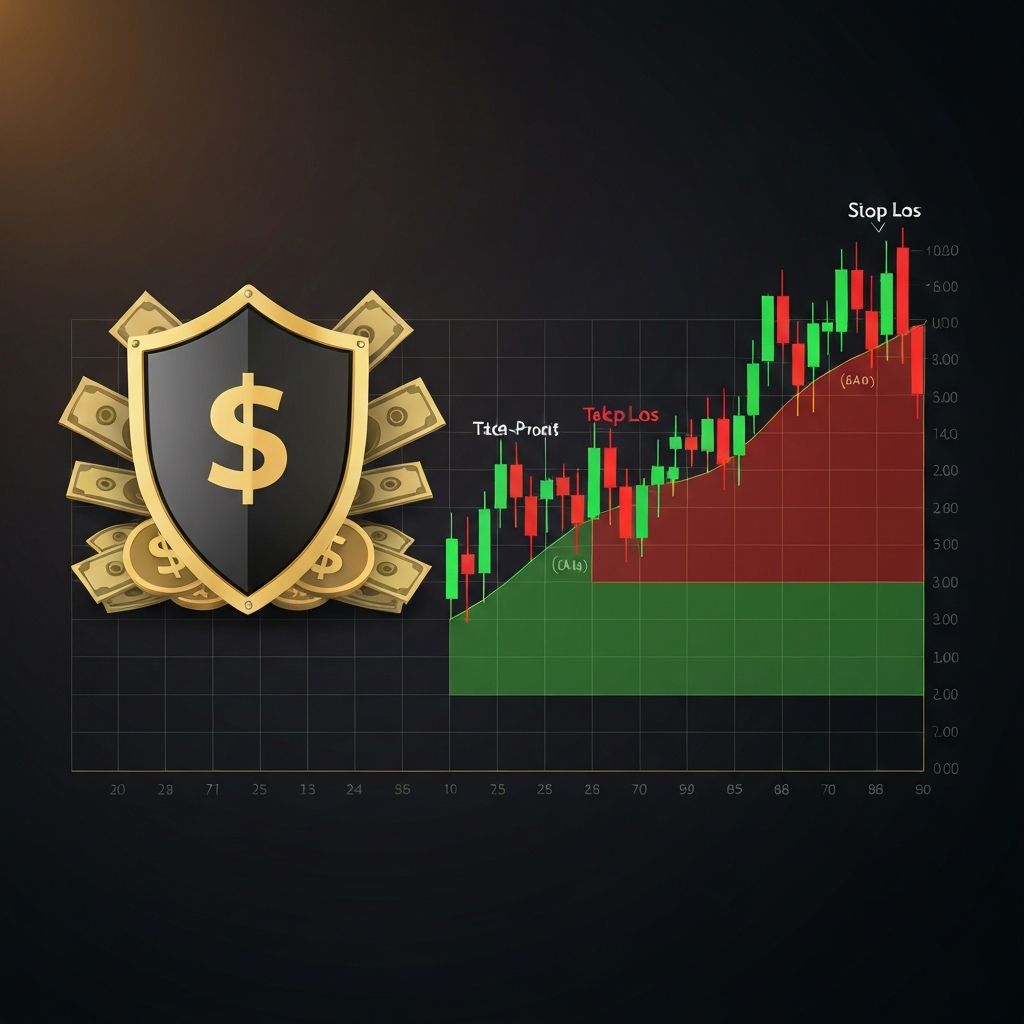
Your stop loss should be placed at the point where the zone is invalidated. For a demand zone, this is below the lowest point of the zone. For a supply zone, this is above the highest point. If price reaches your stop, the zone has failed - there is no point staying in the trade.
- Place stop below the lowest wick of the zone
- Add a buffer of 5-10 pips (forex) or 0.5-1 ATR
- Never place stops at obvious round numbers
- If stopped, the zone has failed - accept it
- Place stop above the highest wick of the zone
- Add a buffer of 5-10 pips (forex) or 0.5-1 ATR
- Account for spread in your stop calculation
- If stopped, the zone has failed - accept it
The Stop Buffer Explained
Markets often wick through zones to grab stop losses before reversing in the expected direction. This is called a stop hunt. By adding a buffer below your zone (for longs) or above (for shorts), you protect yourself from these liquidity grabs while still maintaining a logical invalidation point.
ATR-Based Stop Placement
The Average True Range (ATR) indicator measures market volatility. Using ATR for your buffer adapts your stop to current market conditions. In volatile markets, you need a wider buffer. In calm markets, you can use a tighter buffer.
ATR Buffer Calculation
Step 1: Find the ATR
Use a 14-period ATR on your trading timeframe. For example, if trading the 4-hour chart, use the 4H ATR(14).
Step 2: Calculate the Buffer
Multiply the ATR by 0.5 to 1.0 depending on your risk tolerance. Conservative traders use 1.0 ATR, aggressive traders use 0.5 ATR.
Step 3: Add to Zone Edge
For demand zones: Stop = Zone Low - (ATR × 0.5 to 1.0)
For supply zones: Stop = Zone High + (ATR × 0.5 to 1.0)
Chapter 4: Maximizing Risk-Reward Ratios
The risk-reward ratio (RRR) compares how much you stand to lose versus how much you stand to gain. A 2:1 RRR means you are targeting twice as much profit as you are risking. This ratio is crucial because it determines whether your strategy is profitable over time.
Why Risk-Reward Matters
1:1 RRR
Need 50%+ win rate to profit
Barely break even with most strategies
2:1 RRR
Need 33%+ win rate to profit
Comfortable buffer for most traders
3:1 RRR
Need 25%+ win rate to profit
Professional standard for swing trades
Finding Optimal Targets
For supply and demand traders, the most logical target is the opposing zone. If you are buying at a demand zone, target the next supply zone above. This makes sense because that supply zone is where selling pressure is likely to appear, potentially reversing the move.
Target Option 1: Opposing Zone
Measure the distance to the next significant opposing zone. This is the most logical target as it represents the next area where your trade is likely to face resistance.
Target Option 2: Fixed Risk-Reward
Set your target at a fixed multiple of your risk. For example, if risking 30 pips, target 60 pips (2:1) or 90 pips (3:1). This approach is systematic and removes decision-making.
Target Option 3: Scaled Exit
Take partial profits at multiple levels. For example, close 50% at 2:1 RRR and let the remainder run to the opposing zone with a trailing stop.
The Minimum RRR Rule
Professional traders have a simple rule: never take a trade with less than 2:1 risk-reward. Before placing any trade, calculate your potential profit (distance to target) and divide by your risk (distance to stop). If the ratio is below 2:1, skip the trade regardless of how good the zone looks.
Common RRR Mistakes
- Moving targets closer: Once a trade is live, do not reduce your target because you are nervous. Stick to your plan.
- Ignoring opposing zones: Setting a target beyond an opposing zone is unrealistic. The opposing zone will likely cause a reaction.
- Focusing only on win rate: A 70% win rate with 1:1 RRR underperforms a 40% win rate with 3:1 RRR.
Chapter 5: The Complete Trade Management Framework
Risk management does not end when you place a trade. How you manage the trade from entry to exit significantly impacts your overall profitability. Here is a complete framework for managing supply and demand trades.
Pre-Trade Checklist
Active Trade Management Rules
Rule: Never Move Your Stop Further Away
Once your stop is set, it only moves in your favor (to lock in profit) or stays in place. Moving it away to avoid a loss is the fastest way to blow up an account. If your analysis was wrong, accept the loss and move on.
Rule: Move to Breakeven at 1:1
Once price moves in your favor by an amount equal to your risk (1:1), move your stop loss to breakeven (entry price). This turns the trade into a free trade - you can no longer lose money even if the trade reverses.
Rule: Trail Your Stop Using Structure
As price moves in your favor, trail your stop behind significant swing points. For longs, move your stop below each higher low. For shorts, move it above each lower high. This locks in profit while giving the trade room to breathe.
Rule: Respect Your Targets
When price reaches your target, take profit. Do not get greedy and hope for more. The opposing zone you targeted will likely cause a reaction. Take your planned profit and look for the next setup.
Chapter 6: Advanced Risk Concepts
Correlation Risk
If you trade multiple positions simultaneously, be aware of correlation. Trading EUR/USD and GBP/USD long at the same time is essentially doubling your risk because these pairs move together. If one trade loses, the other probably will too.
Managing Correlation Risk
- Reduce position size when trading correlated instruments
- Set a maximum total portfolio risk (e.g., 5% across all open trades)
- Diversify across uncorrelated markets when possible
- Consider correlated trades as one trade from a risk perspective
The Daily and Weekly Loss Limits
Professional traders set hard limits on how much they can lose in a day or week. When these limits are hit, they stop trading. This prevents emotional revenge trading after losses and protects capital during periods when your analysis may be off.
Daily Loss Limit
Stop trading for the day after losing 2-3% of your account. This is typically 2-3 full losses with proper 1% risk management.
Weekly Loss Limit
Stop trading for the week after losing 5-6% of your account. Take time to review what went wrong before resuming.
Conclusion: Risk Management as a Competitive Advantage
Most traders focus on finding the perfect entry or the best indicator. They spend countless hours searching for a holy grail strategy. Meanwhile, professional traders know that risk management is the real edge. A mediocre strategy with excellent risk management will outperform a great strategy with poor risk management every time.
The concepts in this article are not complex, but they require discipline to implement consistently. Calculate your position size before every trade. Place your stops at logical invalidation points. Only take trades with acceptable risk-reward ratios. Set daily and weekly loss limits. These simple rules, followed consistently, will put you ahead of 90% of traders.
Remember: your goal is not to win every trade. Your goal is to be profitable over a series of trades. By keeping your losses small and your wins big, you create a mathematical edge that compounds over time. This is how professional traders build lasting wealth from the markets.
Ready to Trade Smarter?
ChartLab-IQ helps you identify high-quality supply and demand zones instantly, giving you more time to focus on risk management and trade execution. Stop spending hours drawing zones and start making better trading decisions.
Try ChartLab-IQ Free