
Multi-Timeframe Supply & Demand Analysis: The Professional Trader's Edge
Discover how professional traders use multi-timeframe analysis to find high-probability supply and demand setups. Learn the systematic approach to aligning zones across timeframes for precision entries and maximum profit potential.
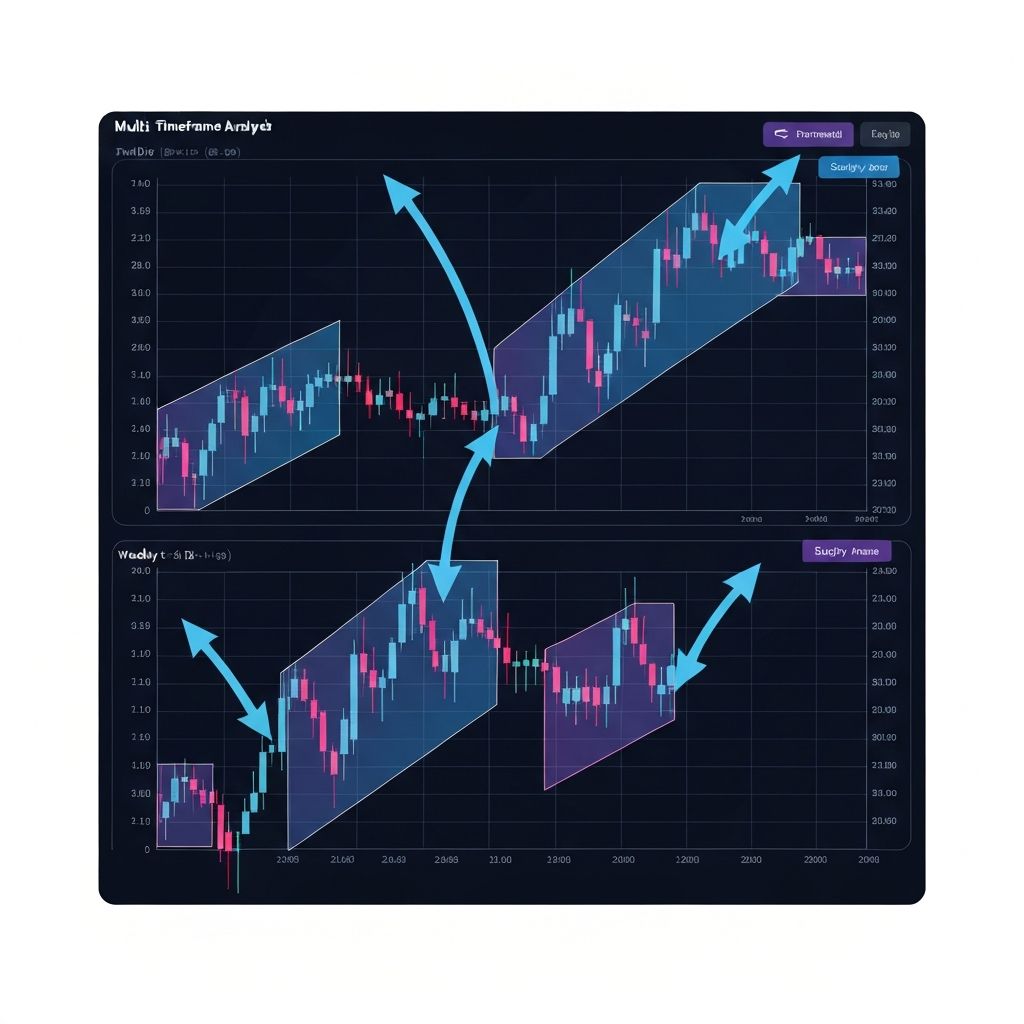
If you've been trading supply and demand zones on a single timeframe, you're leaving significant edge on the table. Multi-timeframe analysis (MTF) is the secret weapon that separates consistently profitable traders from those who struggle with inconsistent results. This comprehensive tutorial will show you exactly how to implement MTF analysis in your supply and demand trading for dramatically improved win rates and risk-reward ratios.
By the end of this guide, you'll understand why higher timeframe zones are more powerful, how to systematically scan multiple timeframes, and how to time your entries using lower timeframe confirmation. Let's dive into the methodology that institutional traders use every day.
Why Multi-Timeframe Analysis Matters
Single timeframe analysis is like looking at a map of just your neighborhood when you're planning a cross-country trip. You might know your immediate surroundings well, but you're missing the bigger picture that determines your ultimate destination. Multi-timeframe analysis gives you that complete view.
The MTF Advantage
- Higher probability setups - Zones that align across timeframes have institutional backing
- Better risk-reward - Higher timeframe zones provide larger profit targets
- Clearer market context - Understand where price is within the larger structure
- Reduced false signals - Filter out noise by focusing on significant levels
- Improved timing - Use lower timeframes for precision entries at key levels
The Hierarchy of Timeframes
Not all timeframes are created equal. Higher timeframes carry more weight because they represent larger pools of capital and longer-term institutional positioning. Understanding this hierarchy is crucial for effective MTF analysis.
Timeframe Weight Hierarchy
The Three-Timeframe Framework
Professional traders typically use a three-timeframe approach: a higher timeframe for direction and major zones, a middle timeframe for trade setup identification, and a lower timeframe for entry timing. This systematic approach ensures you're always trading with the bigger picture in mind.
Higher Timeframe
Direction & Major Zones
- - Determines trend bias
- - Identifies major S&D zones
- - Sets profit targets
- - Defines "no trade" areas
Middle Timeframe
Trade Setup & Structure
- - Identifies trade setups
- - Defines entry zones
- - Sets stop loss levels
- - Confirms HTF direction
Lower Timeframe
Entry & Execution
- - Precision entry timing
- - Confirmation patterns
- - Tight stop placement
- - Early exit signals
Recommended Timeframe Combinations
The ideal timeframe combination depends on your trading style. Here are proven combinations that work well together, maintaining a ratio of approximately 4-6x between each level:
| Trading Style | Higher TF | Middle TF | Lower TF | Hold Time |
|---|---|---|---|---|
| Position Trader | Monthly | Weekly | Daily | Weeks to Months |
| Swing Trader | Weekly | Daily | 4H | Days to Weeks |
| Day Trader | Daily | 4H | 1H | Hours to Days |
| Scalper | 4H | 1H | 15M | Minutes to Hours |
Step-by-Step MTF Analysis Process
Follow this systematic process every time you analyze a trading opportunity. This top-down approach ensures you never miss the bigger picture and always trade in alignment with higher timeframe structure.
The MTF Analysis Checklist
Start with the Higher Timeframe
Identify the overall trend direction and mark all significant supply and demand zones. These are your "big picture" levels that will act as major support/resistance.
Determine Your Trading Bias
Based on HTF analysis, decide if you're looking for longs (price approaching demand) or shorts (price approaching supply). Never trade against the HTF direction.
Move to Middle Timeframe
Look for supply/demand zones that align with HTF zones. These "nested" zones are your primary trading opportunities. Mark specific entry zones and stop loss levels.
Wait for Price to Reach Zone
Be patient. Set alerts at your zones and wait for price to come to you. Chasing price outside of zones dramatically reduces your edge.
Drop to Lower Timeframe for Entry
Once price enters your zone, use the lower timeframe to find confirmation patterns and precise entry points. Look for momentum shifts, engulfing candles, or mini S&D zones.
Execute and Manage
Enter the trade with your predetermined stop loss. Use the middle timeframe for trade management and the higher timeframe for profit targets.
Zone Alignment: The Power of Confluence
The most powerful trading setups occur when supply or demand zones from multiple timeframes overlap or "nest" within each other. This confluence represents areas where traders across all timeframes have interests aligned, creating exceptionally strong levels.
Types of Zone Alignment
Perfect Nest (Highest Probability)
A lower timeframe zone sits entirely within a higher timeframe zone. This represents the strongest confluence where institutional and retail traders are aligned.
- - Win rate: 65-75% with proper execution
- - Risk-reward potential: 3:1 to 5:1+
- - Trade these with confidence and full position size
Partial Overlap (High Probability)
Zones from different timeframes partially overlap, creating a "hot zone" where the overlap occurs. Focus entries on this overlapping area.
- - Win rate: 55-65% with proper execution
- - Risk-reward potential: 2:1 to 4:1
- - Enter only in the overlapping section
Proximity Alignment (Moderate Probability)
Zones don't overlap but are very close to each other (within 0.5% of price). This creates a "zone cluster" that can act as a broader support/resistance area.
- - Win rate: 50-60% with proper execution
- - Risk-reward potential: 1.5:1 to 3:1
- - Use reduced position size or wait for better setup
Lower Timeframe Entry Techniques
Once price reaches your identified zone on the middle timeframe, dropping to the lower timeframe allows for precision entries with tighter stops. Here are the specific patterns to look for:
Entry Confirmation Patterns
1. Momentum Shift
Price enters zone with momentum, then shows clear deceleration and reversal candles.
2. Engulfing Pattern
A strong reversal candle that completely engulfs the previous candle within the zone.
3. Mini Zone Formation
Price creates a small consolidation within the larger zone, then breaks out in your direction.
4. Wick Rejection
Price wicks into the zone and immediately rejects with a long wick candle (pin bar).
Critical Warning: Avoid These Entry Mistakes
- Don't enter blindly at zone touch - Always wait for LTF confirmation
- Don't force entries - If confirmation doesn't appear, the zone may fail
- Don't widen stops - If your calculated stop doesn't fit risk parameters, skip the trade
- Don't ignore HTF context - Even perfect LTF entries fail against HTF momentum
Practical Examples: MTF Analysis in Action
Let's walk through complete examples of how to apply multi-timeframe analysis to real trading scenarios. These examples demonstrate the systematic approach from higher timeframe analysis all the way to entry execution.
Example 1: Swing Trade Long Setup
Weekly Chart (Higher TF):
Price is in an uptrend, currently pulling back toward a weekly demand zone at $145-148. This zone was the origin of a strong rally 3 months ago with 15%+ departure.
Daily Chart (Middle TF):
Within the weekly zone, there's a daily demand zone at $146.20-147.00 from a consolidation breakout. This gives us a refined entry zone with a clear stop below $145.
4H Chart (Lower TF):
Price enters the daily zone. We see momentum slow, then a bullish engulfing candle forms at $146.50. Entry on break above engulfing high at $146.80.
Trade Parameters:
- Entry: $146.80
- Stop: $144.90 (below weekly zone)
- Target 1: $156 (previous daily resistance) - 4.8:1 RR
- Target 2: $165 (weekly supply zone) - 9.6:1 RR
Example 2: Day Trade Short Setup
Daily Chart (Higher TF):
Price is in a downtrend, rallying into a daily supply zone at $52.50-53.20. This zone caused a sharp 8% decline previously.
4H Chart (Middle TF):
There's a 4H supply zone at $52.80-53.00 nested within the daily zone. Clear origin candle with strong departure. Stop goes above $53.25.
1H Chart (Lower TF):
Price rallies into the 4H zone. Momentum candles shrink, then we see a bearish wick rejection at $52.95. Entry on break below $52.70.
Trade Parameters:
- Entry: $52.70
- Stop: $53.30 (above daily zone)
- Target 1: $51.00 (4H demand) - 2.8:1 RR
- Target 2: $49.50 (daily demand) - 5.3:1 RR
Common MTF Analysis Mistakes
Even experienced traders make these mistakes when implementing multi-timeframe analysis. Being aware of these pitfalls will help you avoid costly errors.
Trading Against HTF Direction
Taking counter-trend trades on lower timeframes when the higher timeframe shows strong momentum. The HTF will usually win.
Analysis Paralysis
Checking too many timeframes and getting conflicting signals. Stick to your three designated timeframes only.
Ignoring HTF Zones Overhead/Below
Taking trades without checking if there's an opposing HTF zone nearby that could stop your trade short.
Forcing Alignment
Seeing alignment that isn't really there. If zones don't clearly align, wait for a better setup.
Skipping LTF Confirmation
Entering at zone touch without waiting for lower timeframe confirmation. This leads to many unnecessary losses.
Building Your MTF Trading Routine
Consistency in multi-timeframe analysis requires a structured routine. Here's a daily workflow that ensures you're always prepared and never miss high-probability setups.
Daily MTF Analysis Routine
Morning Prep (15-20 min)
- - Review HTF charts for all watchlist symbols
- - Mark any new zones formed overnight
- - Identify symbols approaching key levels
- - Set alerts at zones of interest
Active Trading (Market Hours)
- - Monitor middle TF for setups approaching zones
- - When alert triggers, analyze all three timeframes
- - Wait for LTF confirmation before entry
- - Manage open positions per your plan
End of Day Review (10-15 min)
- - Update zones on all timeframes
- - Journal any trades taken
- - Note setups developing for tomorrow
- - Review what worked and what didn't
Your MTF Quick Reference Checklist
Before Every Trade:
- HTF direction identified?
- HTF zones marked?
- MTF zone aligns with HTF?
- No opposing HTF zone in the way?
- LTF confirmation pattern present?
Trade Execution:
- Entry price defined?
- Stop loss set (below/above zone)?
- Targets at HTF levels?
- Position size calculated?
- Risk within 1-2% of account?
Conclusion: Elevate Your Trading with MTF Analysis
Multi-timeframe analysis is not optional for serious supply and demand traders - it's essential. By incorporating this systematic approach, you'll immediately notice improvements in your trade selection, timing, and overall results. The key is consistency: always start from the higher timeframe, identify alignment, and use the lower timeframe for precision entries.
Remember, the best trades happen when all timeframes agree. When you see a lower timeframe zone sitting perfectly within a higher timeframe zone, and the overall market direction supports your trade - that's when you strike with confidence. Be patient, wait for these high-probability setups, and your win rate will reflect the edge that MTF analysis provides.
Key Takeaways:
- Always analyze from higher to lower timeframes (top-down approach)
- Use three timeframes: HTF for direction, MTF for setup, LTF for entry
- Nested zones (perfect alignment) offer the highest probability trades
- Never trade against higher timeframe direction
- Always wait for lower timeframe confirmation before entry
Ready to Master Multi-Timeframe Analysis?
ChartLab-IQ's AI automatically identifies supply and demand zones across all timeframes, helping you find aligned setups faster. Stop spending hours drawing zones manually - let AI do the heavy lifting while you focus on execution.